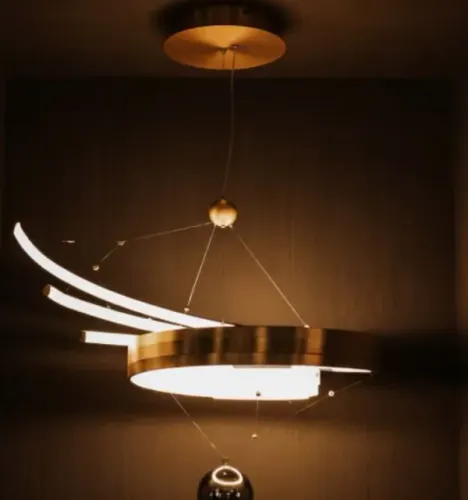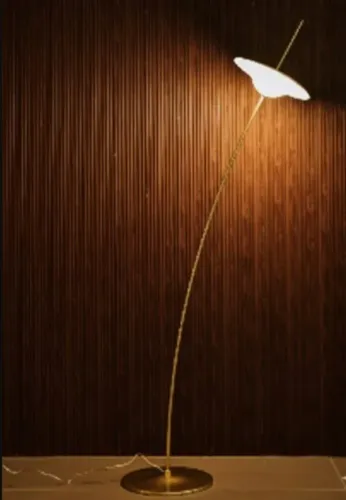
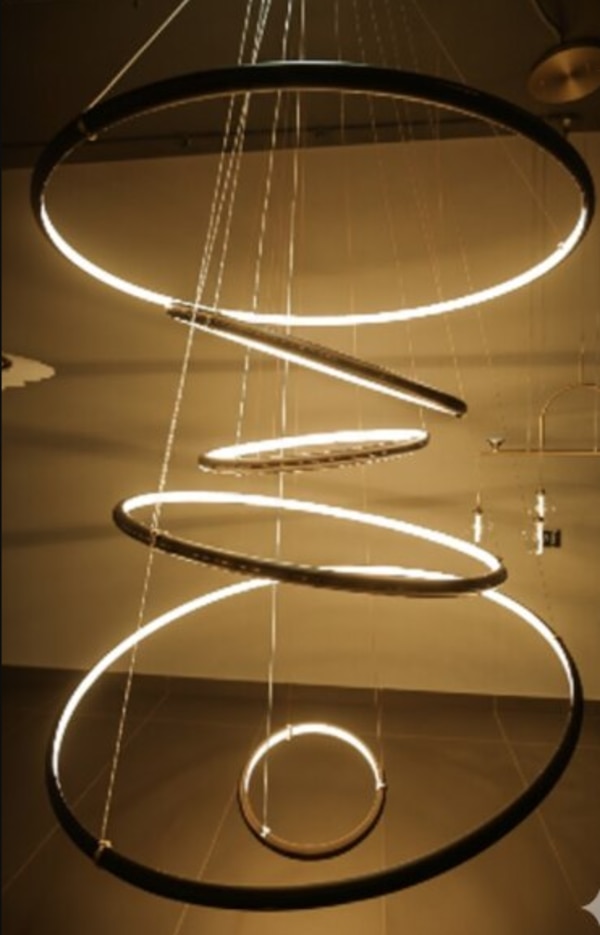
A double-height room needs more than a dramatic object suspended from the ceiling: its scale, drop, brightness, structure and maintenance access must work together. By the end, you can compare a three-pendant composition with other formats, calculate a practical starting size, and prepare the questions needed for a safe Delhi installation.
Key takeaways
- Use three pendants for rhythm; choose one sculpture for a dominant focal axis.
- Size the fitting from room volume, viewing distance and the intended visual weight.
- Specify lumens, colour temperature and CRI—not wattage alone—for high pendant lighting.
- Coordinate structural fixing, electrical points, access equipment and maintenance before ordering.
Which installation suits a double-height room: three pendants, one sculpture or another format?
Choose three pendants when you want rhythm across a broad void; choose one sculpture when the room has one dominant axis and needs a strong object-like centrepiece.
A double-height pendant installation combines the fixture or group, its vertical drop, suspension point and the empty volume around it. For a double height three or pendant installation for grand spaces in Delhi, judge how that composition looks from the entrance, staircase, sofa, dining table and upper-floor railing before ordering.
| Option | Best use | Main limitation |
|---|---|---|
| Single sculptural pendant | One dominant axis and a memorable focal point | Can leave distant areas visually or practically underlit |
| Three pendants | Rhythm across a foyer or broad square void | Each drop needs independent height adjustment for balcony-level balancing |
| Linear installation | Long dining table, reception desk or corridor | Looks misplaced in a square void |
| Chandelier | Concentrated, symmetrical centrepiece | Does not suit every sightline or informal layout |
| Recessed or track lighting | General, wall or artwork illumination | Fills the room with light without filling the vertical volume |
For a pendant installation for grand room in Delhi, select the format by the job: visual drama, useful ambient light, table illumination or clear foyer views. A cluster needs separate suspension cables and accessible drivers; a fixed canopy makes later levelling difficult.
Treat the decorative fitting as one lighting layer. Add concealed, wall, recessed or track lighting for stairs, entrances, reading, artwork and circulation, because a source 6 metres above the floor cannot illuminate like the same source at 3 metres.
How do you calculate size, drop and clearance before ordering?
Calculate from the room volume, furniture and circulation clearances, then set the fitting’s diameter and drop. A catalogue image cannot prove brightness, structural capacity or glare control.
1. Measure the room length, width and height, then mark the sofa, dining table, console, balcony edge and main walking lines. For one central fitting, add the room length and width in feet to get a rough diameter in feet. Treat this only as a visual starting point, not a safety or lighting calculation.
2. For three pendants, divide the visual span across the furniture or void and leave enough separation for each form to read clearly from the balcony and floor below. Record the suspension point and each independent drop so the group can be levelled after viewing it from both levels.
3. In a foyer, measure clear width, door distance and the intended walking line before choosing the lowest element.
A large decorative light for a foyer in Delhi must stay outside door swings and above the route, with at least 2.1 m of headroom; increase that clearance where children, tall users or moving doors create conflict.
4. In a stairwell, record void length and width, top and bottom landings, railing height and every turning point. For a pendant installation for a grand room in Delhi, keep the lowest point 750–900 mm above a dining tabletop as a starting range, then adjust for its shape, occupants’ eye level and future taller furniture.
Do not leave the fitting near a balcony edge without checking the drop from both levels.
How bright should a high pendant be, and which LED specification matters?
A high pendant supplies atmosphere, not automatic task lighting. Doubling the source-to-surface distance cuts direct illuminance to about one-quarter under the inverse-square relationship, so a fitting 6 m above a foyer floor cannot light it like the same fitting at 3 m.
Use concealed, wall, cove, recessed or track lighting for stairs, entrances, artwork, seating and reading areas.
| Colour temperature | Suitable setting | Result |
|---|---|---|
| 2700–3000 K | Homes, hotels and relaxed hospitality | Warm, intimate appearance |
| 3000–3500 K | Contemporary commercial interiors | Cleaner, more neutral appearance |
| 4000 K | Work-oriented interiors | Neutral appearance; avoid it when softness is the goal |
Request total lumens, not wattage alone. Diffuser transmission and optical efficiency alter visible output, so wattage does not reveal how bright the pendant will look. Ask for CRI 90 or higher where skin, timber, stone, artwork or food must appear accurate.
Before approving a sculptural high ceiling light in Delhi, review it from the floor, staircase, mezzanine and upper corridor. Check beam spread, diffuser opacity and floor-and-wall shadows; exposed LED points, polished metal and glass can cause discomfort glare even when the floor appears bright.
Confirm these specifications as one compatible system:
- LED driver type, dimming protocol and expected operating temperature
- Phase-cut, DALI or 0–10 V control compatibility
- Flicker, buzzing and minimum-dimming performance
An incompatible driver and dimmer can flicker, buzz, dim poorly or fail early. Let the pendant provide visual identity and controlled ambient light while lower layers handle safe movement and useful illumination.
What must be fixed, coordinated and documented before installation?
The electrical junction box and structural suspension point are separate design items. A gypsum or false ceiling must not carry the full weight of a large metal, glass or crystal fitting; anchor the suspension to a slab, beam or engineered support with a documented load capacity.
1. Before the ceiling closes, mark the canopy and drop against sprinklers, smoke detectors, HVAC supply and return grilles, ceiling fans, beams, skylights and access equipment. A central fitting can obstruct detector coverage or become impossible to clean.
2. Ask for a reflected-ceiling and installation drawing, not a catalogue image. It must show the canopy location, fixture weight, suspension lengths, fixing detail, driver position, cable route and maintenance access.
3. Check the fitting against Delhi’s 230 V, 50 Hz supply. Confirm earthing, driver requirements, terminal connections and replacement parts, especially for imported products; physical fit does not prove electrical compatibility.
4. Record how the lowest element, glass sections and LED driver will be reached. Confirm whether cleaning or replacement needs a lift or scaffold, who will isolate the supply, and whether glass can be removed without dismantling the full suspension.
Delhi dust and outdoor pollution make intricate exposed fittings harder to maintain than smooth, enclosed forms. Ask a practical double height lighting provider in Delhi to state cleaning frequency, replacement-glass availability and independent drop adjustment. If Kimika Lights is shortlisted, request these documents before site work.
Commercial projects also require checks against the Energy Conservation Building Code, emergency lighting, fire provisions and occupancy-specific requirements.
Related products
 | Double Height – III – Sculptural Lighting for Grand Spaces Double Height – III – Sculptural Lighting for Grand Spaces Double Height – III from Kimika Lights combines artistic structure with premium illumination to enhance tall interiors with breathtaking elegance. View product → |
 | Double Height – I – Grandeur for Elevated Spaces Double Height – I – Grandeur for Elevated Spaces Double Height – I from Kimika Lights is designed to make an unforgettable statement in tall, expansive interiors. View product → |
How should you make the final choice for a Delhi foyer, staircase or grand room?
A room-by-room sequence gives you a safer final choice than selecting by ceiling height alone. For a large decorative light for foyer in Delhi, measure the entrance width, door swing, floor-to-ceiling height, upper-level sightlines and walking route before choosing one sculpture or a three-pendant cluster. Add wall or concealed light so the floor remains visible.
| Option | Choose it when | Check before approval |
|---|---|---|
| Linear installation | The room is long or has a dining table | Align it with the table, desk or room axis |
| Pendant cluster | You need rhythm across a broad void | Confirm each drop can be adjusted independently |
| Single sculpture | One dominant axis needs a focal point | Check its lowest element against every sightline |
1. For a staircase, check every landing and turn. Keep the drop outside the movement envelope, then add low-glare step or wall lighting instead of relying on a fitting over the void.
2. For dining, size the composition to the table, not the room. Start 750–900 mm above the tabletop and add dimming for meals and circulation.
3. For a long grand room, compare a linear installation with a cluster; reserve adjustable accent output for artwork or architectural details.
4. View a sculptural high ceiling light in Delhi from the entrance, sofa, stair, gallery and balcony. Request a mock-up or scaled drawing near a sightline, then record the final drop, weight, driver location, cleaning method and control scene in handover documents.
Frequently asked questions
Which installation suits a double-height room: three pendants or one sculpture?
Choose three pendants across a broad void when you want rhythm and distributed emphasis. Choose one sculptural fitting when the room has a dominant axis and needs a single centrepiece.
How do you calculate pendant size, drop and clearance?
Measure the room width, length, floor-to-ceiling height and sightlines from every approach. Use those dimensions to set the fitting scale, suspension length and clearance above people, doors, stairs and furniture before ordering.
How bright should a high pendant be, and which LED specifications matter?
Compare total lumens, beam distribution, colour temperature and colour rendering index. Select the output for the room’s task lighting and use dimming when the pendant also serves as decorative ambient light.
What must be coordinated before a pendant installation in Delhi?
Confirm the structural fixing point, ceiling construction, electrical supply, dimmer compatibility, access equipment, delivery route and maintenance plan. Record the fitting dimensions, suspension length, driver location and installation drawings.
How do you choose a large decorative light for a Delhi foyer or grand room?
Compare the foyer’s geometry, staircase alignment, viewing distance, daylight levels and maintenance access. Select three pendants, one sculpture or another format only after checking scale, glare, structural support and serviceability.
Related products
 | Double Height – II – Dramatic Lighting for Grand Interiors Double Height – II – Dramatic Lighting for Grand Interiors Double Height – II by Kimika Lights is crafted to elevate expansive spaces with striking elegance. View product → |
 | Pendants – III – Artistic Lighting with Modern Sophistication Pendants – III – Artistic Lighting with Modern Sophistication Pendants – III by Kimika Lights features a contemporary silhouette crafted to enhance both residential and commercial interiors. View product → |
 | Double Height Light Kimika Lights offers a refined blend of modern style and functional illumination. View product → |
 | Pendants – IV – Elegant Illumination with Sculptural Appeal Pendants – IV – Elegant Illumination with Sculptural Appeal Pendants – IV from Kimika Lights brings a blend of refined artistry and modern elegance to any interior. View product → |
Keywords