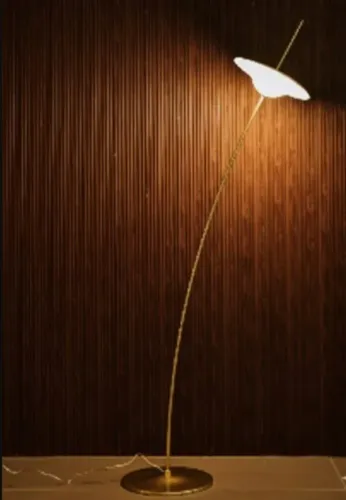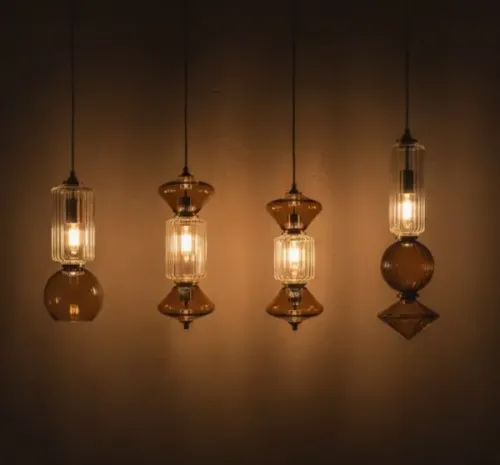
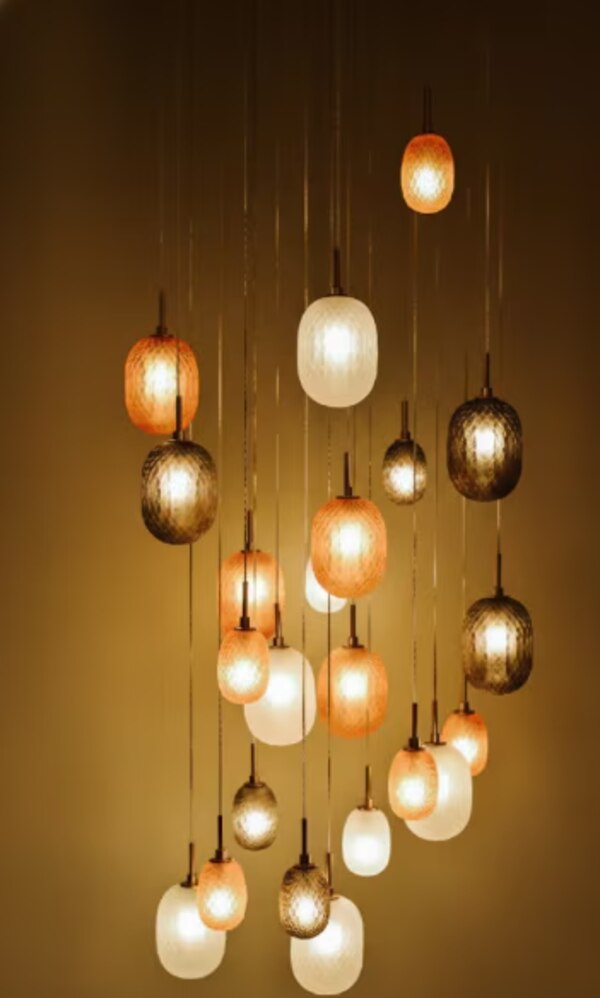
A tall café volume needs more than one dramatic pendant: the fixture must fit the ceiling structure, keep customers and staff clear, and deliver comfortable light to tables, menus and counters. By the end, you will have a practical method for planning locations, checking technical specifications, comparing alternatives and testing a proposal before installation.
Key takeaways
- Centre fixtures over active focal zones, not empty ceiling bays.
- Light tables, counters and circulation routes as separate tasks.
- Specify glare control, warm colour temperature and dimmable drivers.
- Confirm cleaning access, mounting structure and replacement logistics before approval.
Map the Café Before Choosing a Double-Height Fixture
Place a double-height fixture over a deliberate focal zone—such as a central dining table cluster, bar, entrance, stair landing or visible void—not in an empty ceiling bay. Map the café first, because a pendant centred in the room can leave the tables, counter and circulation path poorly lit.
Measure these points before selecting the fitting:
- Finished floor to slab, truss or suspended ceiling
- The exact mounting point and available access for a lift, scaffold or maintenance rig
- Fixture height, diameter, suspension drop and lowest point
- Tabletop height, table positions, counter height and customer sightlines
- Walking routes, stair nosings, door swings and staff service paths
Keep the lowest part at least 2.1 metres above walking surfaces and stair nosings. Over a table, allow about 750–900 millimetres between the tabletop and fixture, then check that nobody enters the pendant’s clearance zone during service.
| Placement | Strength | Main risk |
|---|---|---|
| Dining cluster | Gives tables a visual centre | Tabletops stay dim without separate task light |
| Bar or counter | Marks the service destination | Staff may strike a low drop during work |
| Entrance or stair | Creates arrival drama | Glare and head clearance need careful checking |
| Central void | Fills the tall volume | Light can spill above the occupied zone |
For double-height lighting for cafes in Delhi, model furniture, dark finishes, ceiling and wall reflectance, daylight and the luminaire’s photometry. Tall ceiling lighting in Delhi fails when a large lumen total disappears into the upper volume; include table, counter and wall-wash lighting in the calculation.
Plan Light at Tables, Counters and Circulation Routes
Make the decorative pendant an accent, not the room’s only light. A double-height café needs separate illumination for ambient brightness, tabletops, counters and circulation, or a striking fixture can leave guests reading menus in shadow.
Give each occupied zone its own source:
- Tables: use focused downward light over dining surfaces, with the beam centred on the table rather than the customer’s eyes.
- Bar or service counter: add continuous task lighting under shelves or above the worktop so staff can prepare drinks and read orders.
- Walkways, entrance and stairs: light the floor and changes in level evenly; do not rely on a pendant over a nearby table.
- Walls and upper volume: use wall-washing or grazing to reveal columns and the tall architecture instead of leaving a black void above bright furniture.
For restaurant high ceiling lights in Delhi, request a calculation based on the actual luminaire photometry, furniture layout, ceiling height, daylight and wall reflectances. Dark finishes and beam spill can make a room appear bright while the occupied zone remains short of useful light.
Put table, counter, perimeter, decorative and cleaning circuits on separate controls. This lets daylight-facing fittings dim before evening service and prevents a bright centrepiece from overpowering a small seating area. Include cleaning access in the plan: exposed lamps and textured shades collect Delhi dust faster than smooth, enclosed fittings.
Set Colour, Glare and Control Requirements
For a brief covering double height lights for cafes in delhi, specify performance rather than judging the pendant by wattage or appearance.
Use photometric data at the table and counter: a 24° beam mounted 8 m above a table produces about a 3.4 m diameter before spill, so a narrow beam can leave nearby seats dark.
| Specification | Target | If you miss it |
|---|---|---|
| Colour rendering | Ra/CRI 90 or higher; check TM-30 Rf and Rg | Food colours look dull or unnaturally saturated |
| Colour temperature | 2700–3000 K for dining; keep adjacent fittings consistent | Mixed white tones make food and interiors appear mismatched |
| Glare control | Shielded LEDs, suitable cut-off, and calculated UGR below 19 where applicable | Seated guests see bright sources and tire quickly |
| Beam distribution | Confirm table, bar and wall coverage from the mounting height | A dramatic centrepiece leaves working surfaces underlit |
| Flicker | PstLM ≤ 1.0 and SVM ≤ 0.4; name the compatible dimmer | Video banding, eye discomfort and distracting movement effects |
| Control | Dimming, scene presets and separate ambient, task and accent circuits | Staff cannot adapt light for service, daylight or cleaning |
Check glare from normal seated and standing viewpoints, not only directly beneath the fitting. Treat the pendant as decorative or accent light, then provide separate illumination for tables, menus, counters and circulation. Confirm the driver’s minimum dimming load before installation; an incompatible control can flicker even with a high-quality LED.
Compare Dramatic Pendants with More Flexible Alternatives
A large suspended centrepiece earns its place when the void itself is the café’s feature: over a central table cluster, entrance vista or stair landing where guests approach from several directions. Choose it when its scale remains visible across the full height and lift or scaffold access is planned before the ceiling closes.
| Option | Main advantage | Better choice when |
|---|---|---|
| One dramatic pendant | Creates a strong focal point | The café has a central void, clear sightlines and planned maintenance access |
| Several medium pendants | Spreads visual weight and light | A long dining zone needs more even coverage and simpler replacement |
| Compact pendants or track fittings | Keeps drops, glare and obstructions manageable | The bar, service route or seating layout changes frequently |
| Sealed surface or linear fittings | Protects performance with easier cleaning | Delhi dust, low access or frequent maintenance make exposed lamps impractical |
Do not rely on a centrepiece for usable illumination. Add separate ambient light, table-level light, bar task light and wall-washing so the upper volume does not become a black void above bright tables.
For grand cafe lighting in Delhi, specify the pendant’s compatible dimmer, minimum dimming load and flicker performance. PstLM ≤ 1.0 and SVM ≤ 0.4 provide clear reference limits for covered light sources.
Choose smaller fittings when a failed driver would require specialist rigging, or when open shades and textured surfaces would turn cleaning into a recurring operating cost.
Approve the Fixture Only After a Site and Maintenance Check
Request a scaled drawing before approving any double height lighting for cafes in Delhi. It should show the fixture’s overall diameter, weight, suspension drop, canopy size, driver location, mounting hardware and minimum clearance from tables, walkways, stairs and sprinklers.
Ask for the IES or LDT photometric file too; a narrow 24° beam mounted 8 metres above a table produces roughly a 3.4-metre beam diameter before spill and real-room losses.
Use this supplier checklist before ordering:
- Confirm the ceiling support: slab, beam or truss, anchor type, safe working load and access for drilling. Do not attach a heavy fitting to a false ceiling grid.
- Obtain the driver model, dimmer compatibility, minimum dimming load, flicker data and replacement-driver procedure. For grand cafe lighting in Delhi, ask whether the source meets PstLM ≤ 1.0 and SVM ≤ 0.4 where those limits apply.
- Ask how lamps, LED modules, shades and drivers are replaced, including the lift, scaffold or rigging required and the service clearance.
- Verify the cleaning method and frequency. Delhi dust makes open lamps and textured shades harder to maintain than smooth, enclosed fittings.
- Mark the fixing point on site, then check the final drop against staff movement, customer head height, doors, fans, signage and sprinklers.
Have the electrical contractor confirm cable routes and isolation access before drilling. Kimika Lights can supply a decorative option, but treat its maintenance drawing as essential evidence, not a styling detail. The same checks apply to restaurant high ceiling lights in Delhi.
Related products
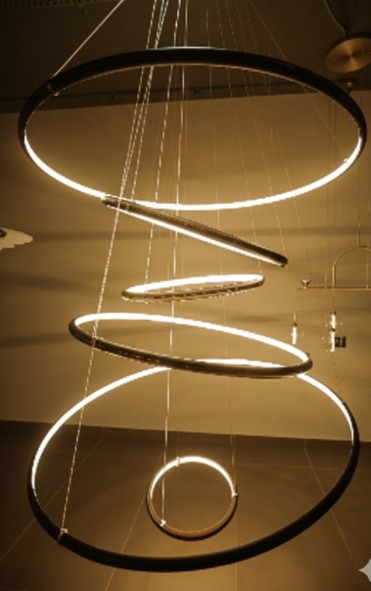 | Double Height – III – Sculptural Lighting for Grand Spaces Double Height – III – Sculptural Lighting for Grand Spaces Double Height – III from Kimika Lights combines artistic structure with premium illumination to enhance tall interiors with breathtaking elegance. View product → |
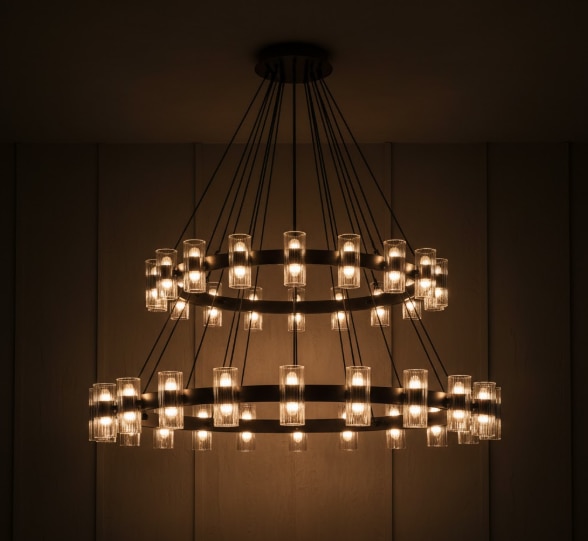 | Double Height – I – Grandeur for Elevated Spaces Double Height – I – Grandeur for Elevated Spaces Double Height – I from Kimika Lights is designed to make an unforgettable statement in tall, expansive interiors. View product → |
Frequently asked questions
Where should you place double-height lighting in a Delhi café?
Place a dramatic fixture over a deliberate focal zone, such as a dining cluster, bar, entrance, stair landing or visible void. Map tables, counters and walkways first so the fixture does not leave working areas underlit.
How should you plan light for tables, counters and circulation routes?
Treat each area separately: provide comfortable, even light at dining tables, stronger task light at counters, and continuous, glare-controlled illumination along circulation routes.
What colour, glare and control requirements matter for tall-ceiling café lighting?
Choose a warm colour temperature suited to the café’s finishes, shield bright lamps from seated and standing sightlines, and specify dimming or scene controls for daylight, service and evening use.
What should you check before approving a restaurant high-ceiling light?
Confirm the ceiling structure, mounting method, installation equipment, cleaning access, driver location, cable routing and how staff will replace lamps or components without disrupting service.
Related products
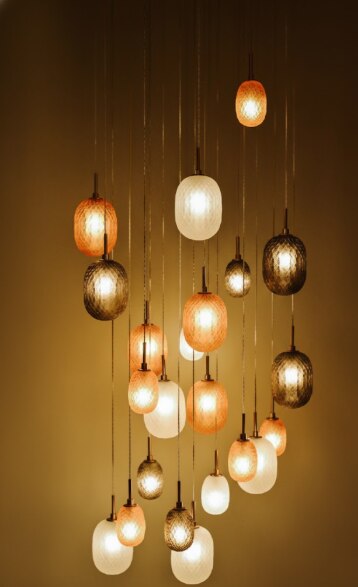 | Double Height – II – Dramatic Lighting for Grand Interiors Double Height – II – Dramatic Lighting for Grand Interiors Double Height – II by Kimika Lights is crafted to elevate expansive spaces with striking elegance. View product → |
 | Double Height Light Kimika Lights offers a refined blend of modern style and functional illumination. View product → |
 | Double Height Light Kimika Lights brings refined simplicity and warm illumination to any interior. View product → |
Keywords